
 September 26 – December 20

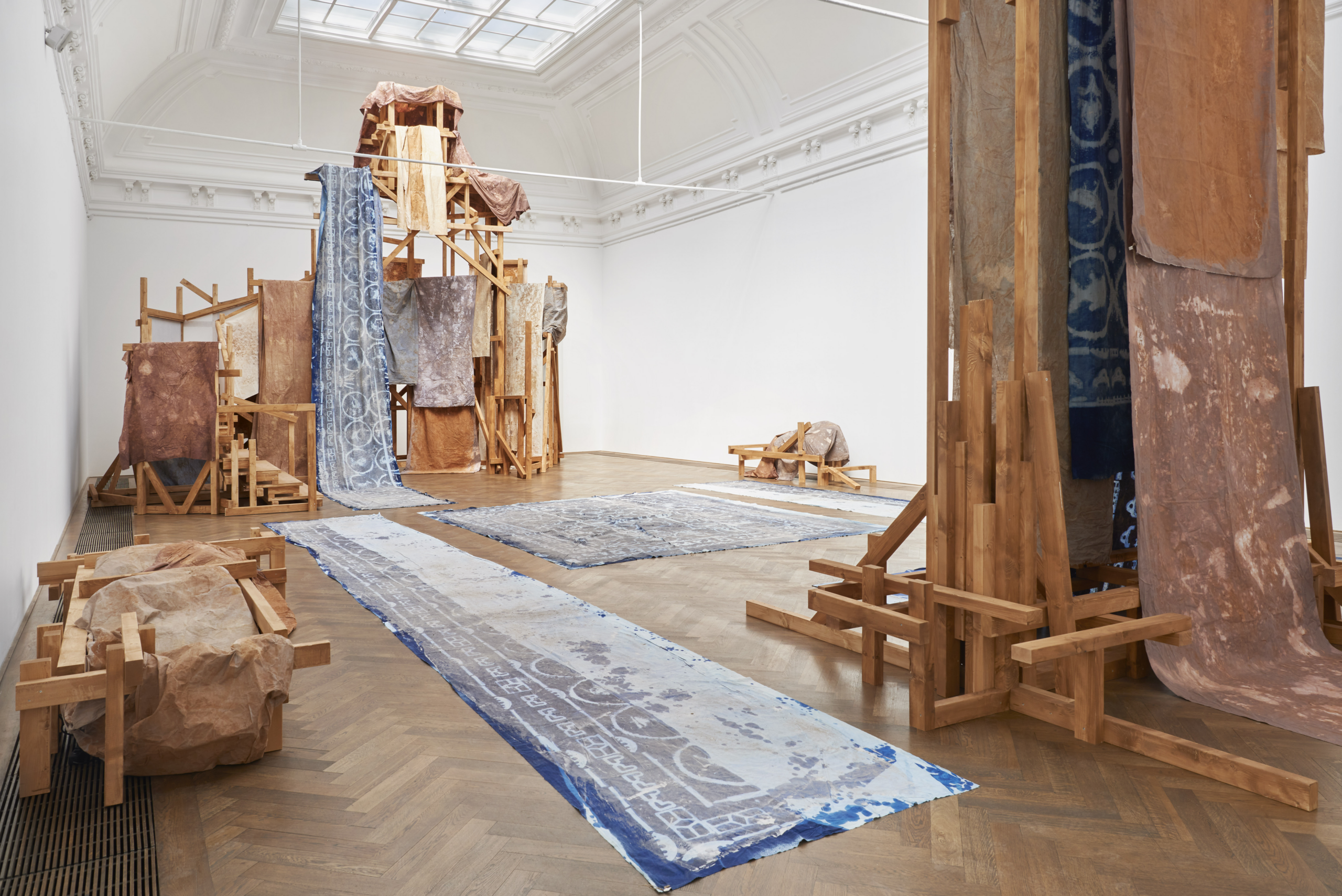
Intricate Byzantine mosaics once adorned the floor of the Church of Saint Christopher, a sixth-century church located in Hannaouiye, the remains of which are located on contested land near Tyre, Southern Lebanon. When discovered during a French-led expedition to Lebanon and Syria in 1862, the ruins of the mosaic were taken to the Musée du Louvre and fragments of it are currently on view. Combining the ancient Greek word ξίλωμα, or xíloma, which means to “rip” or “rupture,” with the Roman numerals for 1,386, the number of years that the mosaic was immersed in the land, Xíloma. MCCCLXXXVI (2025) is both trace and evidence of this disruption. These large cyanotype fabrics were dyed using bricks and shrubbery exposed to sunlight to recreate the motifs from the mosaic floors. Draped across wooden scaffolds made of softwood lumber, the fabrics in this fragmented installation become representative of the enduring dislocation of these materials from their original sites and of communities from their ancestral homelands.
The sonic installation located within Xíloma’s architecture was developed in collaboration with architect and composer Mhamad Safa in the style of a Byzantine chant. Here, two voices mirror each other: one is the voice of the floor itself, being taken across the Mediterranean, and the other is the voice of a migrant being smuggled into fortress Europe. Both are uprooted and traded across the sea. In this current moment of continued atrocities, including airstrikes against Lebanon, Dala’s work is a grounding reminder of the need to hold, carry, and also resist.
Co-presented by the Toronto Biennial of Art and the Art Museum at the University of Toronto and made possible with the generous support of the Women Leading Initiative.
Bio

Bio
Dala Nasser
Dala Nasser (b. 1990, Tyre; lives and works in Beirut and London) received an MFA from Yale University (2021) and a BFA from University College London (2016). As an artist working through abstraction and alternative forms of image-making, Dala integrates sound, performance and film in her practice, but remains quintessentially a painter as she thinks through abstraction and the medium’s most elementary materials: fabric, pigments, stretcher bars, mark making.
In her practice, Dala understands material not only as form but as a witness to historical conditions, marked by the enduring forces of colonial systems and the ecological and psychological disintegration they cause. Her works emerge through processes in which materials act as agents of memory and testimony. She works with natural elements such as soil, ash, clay, charcoal, plants, and insects, each intimately tied to the landscape. Applied to fabric through acts of staining, soaking, dyeing, and rubbing. Often created via frottage on land or spiritual sites, these works serve as archives: porous surfaces that register the traces of lived experience and environmental transformation foregrounding non-claimed histories, ecologies of slow violence, and colonial theft in times and places where human language has been rendered insufficient or out of reach.
Selected solo exhibitions include: Nottingham Contemporary (forthcoming); Kunsthalle Basel (2025); Renaissance Society, Chicago (2023); Kölnischer Kunstverein, Cologne (2022); and V.O Curations, London (2022). Selected group exhibitions include: Aichi Triennale, Nagoya (2025); Aïshti Foundation, Beirut (2025); Accelerator, Stockholm (2025); Wellcome Collection, London (2025); Espoo Museum of Modern Art (2025); Whitney Museum of American Art, New York (2024); Diriyah Contemporary Art Biennale, Riiyadh (2024); 15th Sharjah Biennial (2023); 58th Carnegie International, Pittsburgh (2022); and Beirut Art Center (2019). Nasser is a recipient of Isola Sicilia Prize (2022) and 32nd Salon D’Automne Emerging Artist Prize (2017). Nasser has participated in residencies at V.O Curations, London (2021); Gapado AIR, Jeju Island (2019); and Ashkal Alwan, Beirut (2017).
Nasser’s work is in the collections of Aïshti Foundation, Beirut; Hartwig Art Foundation, Amsterdam; Qatar Museums; and Tate, London.
Photo by Paul Gorra.
-
Accessibility
Art Museum at the University of Toronto - Justina M. Barnicke Gallery
Accessible entrance and washrooms
Accessible ramps / elevators
AODA compliant building
Accessible parkingJustina Barnicke Gallery (7 Hart House Cir.) Accessible Entrance: Use the entrance at 7 Hart House Circle (southeast entrance) or the accessible ramp at Tower Road (2 Tower Road).
-
Getting There
Art Museum at the University of Toronto - Justina M. Barnicke Gallery
Parking: Limited Paid
TTC: Near Museum station; Queen’s Park station; St. George Station; 506 Carlton streetcars
Donors & Supporters
Partners
