
 September 26 – December 20

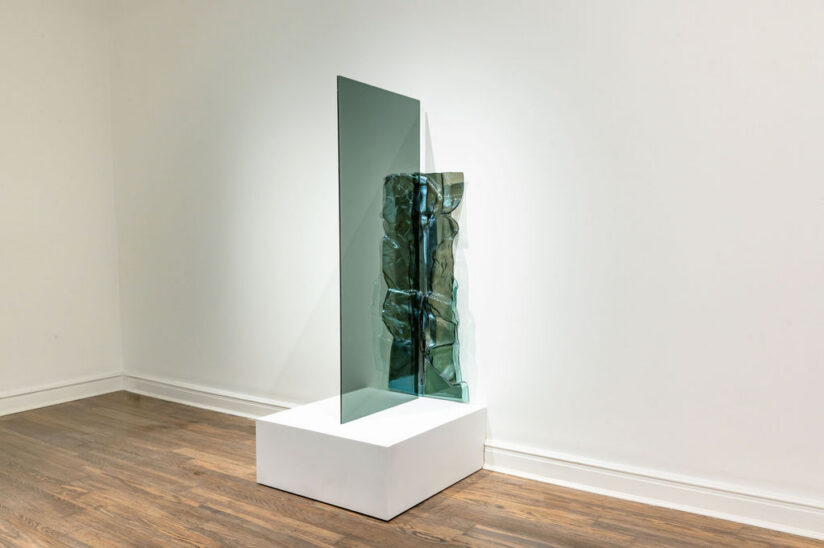
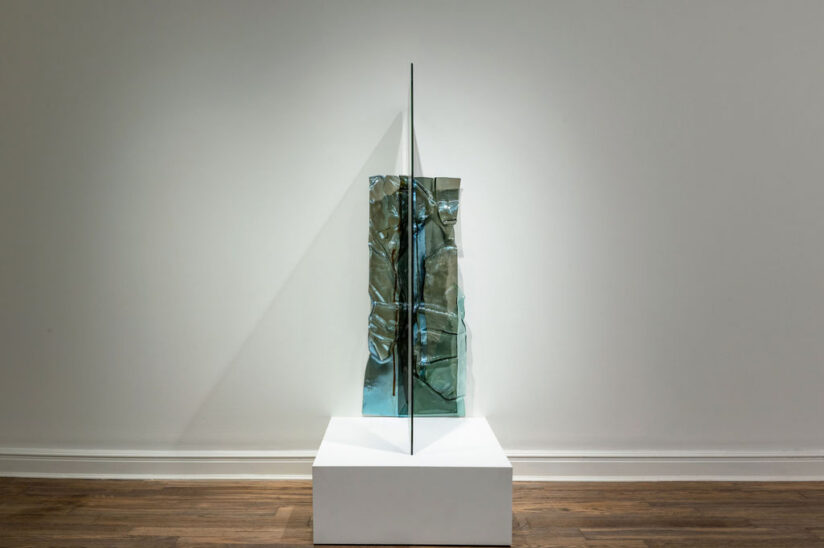
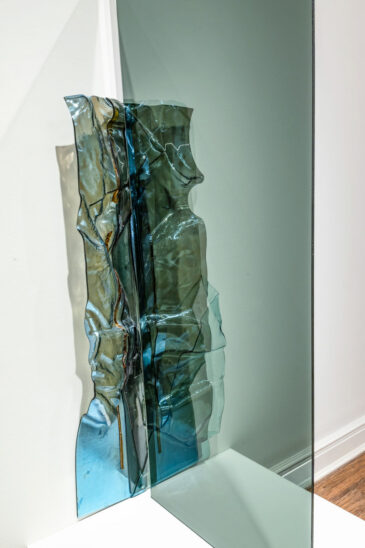
Charisse Pearlina Weston’s most recent work explores the Lacanian concept of méconnaissance (misrecognition). Driven by a desire and need to reconcile how we see and understand ourselves in the world, méconnaissance names a psychical operation where we identify with alienating, false narratives or fantasies in order to constitute our subjectivity. With regard to the Black subject, for Charisse, “this is never only alienation but a violent intimacy: a compulsory surveillance that, like the bright flash of a camera, renders the subject invisible in the very moment of exposure. But this is a blindness that never ends.” Her work, mé-prendre (i saw it ooze in stiffly, saw it lurk along my sharp upper edges where hard and abrasive surfaces collapse the inside) (2025), was created by fusing and slumping panes of surveillance glass, which are then held upright by the force of another, unmodified pane of tempered glass. By applying pressure to the material, Charisse withdraws the conditions necessary for surveillance to function, allowing the material to become something other than itself. As scholar Christina Sharpe articulates, “Black redaction and Black annotation are ways of imagining otherwise.” Charisse deconstructs and repositions materials as a strategy of refusal to maintain the opacity, and therefore the interiority, of Black life.
Co-presented by the Toronto Biennial of Art and the Art Museum at the University of Toronto and made possible with the generous support of the Women Leading Initiative and Jack Shainman Gallery
Bio
Bio
Charisse Pearlina Weston
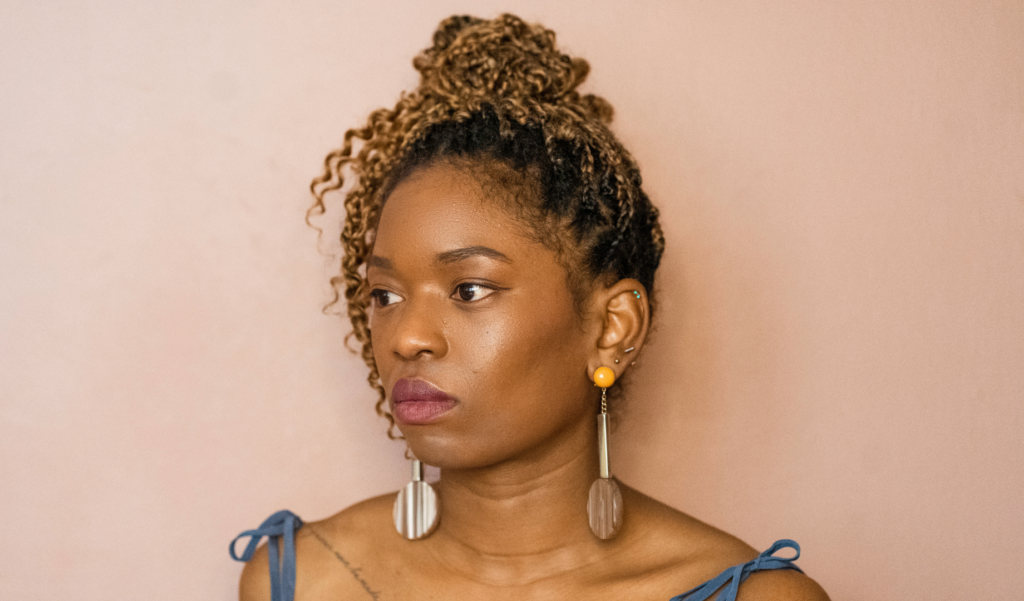
Charisse Pearlina Weston (b. 1988, Houston, TX; based in Harlem, NY) is a conceptual artist and writer whose work contends with the dynamic interplay of violence and intimacy through repetition, enfoldment, and concealment.
Weston’s artistic practice interrogates the dialectics of Black interior life and resistance. She explores how the physical and ideological structures of power and surveillance enforce constrictive intimacies and how these intimacies enact violence. Working across mediums, Weston deploys strategies of repetition, fragmentation, enfoldment, and concealment to reimagine Black interiority as a site of refusal and radical possibility.
Central to her artistic methodology is the reuse and re-articulation of elements from past work to formulate the next. In these new forms, repetition functions as both a symbol of Black cultural production and Blackness’s reliance on an order of temporal engagement in which the second time encodes an emergent originality. Through text layered between materials or etched onto their surface, Weston considers the entropic capacity of language. Within a poetics emerging from the infinite liquidity of Blackness, words shatter, phrases fragment, and meaning slips, thus allowing the boundaries of established meaning and dominant thought to rupture.
Glass conceptually embodies both the everyday risk of anti-Black violence and the precocity and malleability of Blackness in the face of this violence. With enfoldment, Weston creates secret spaces of withholding as a tactical response to this risk. These folds ensnare and conceal poetic fragments and forge a fugitive realm within the terrains of Black interior life.
In Weston’s work, the fragile, sharp edge cuts and reorients space, while crumbling, rough foundations balance and threaten already fractured panes. The construction of these tensions allows her to explore the seemingly incongruent material and symbolic conditions of Black life.
Weston received a BA from the University of North Texas, an MSc in Modern Art: History Curating and Criticism from the University of Edinburgh’s Edinburgh College of Art, and an MFA in Studio Art with Critical Theory emphasis from the University of California-Irvine. She is an alumna of the Whitney Museum of American Art’s Independent Study Program.
Weston participated in the 2024 Whitney Biennial and 12th SITE SANTA FE International Biennial in 2025 and has exhibited in groups at other notable venues, including the Studio Museum in Harlem, MoMA PS1, Contemporary Arts Museum Houston, and Hessel Museum of Art at Bard College. She has mounted solo exhibitions recently at the Queens Museum, Center for the Arts at Virginia Tech, Moody Center for the Arts at Rice University, Recess, and Project Row Houses. She was a 2025 Guggenheim Fellow, 2023-24 Hodder Fellow at the Lewis Center for the Arts at Princeton University, 2023 Jerome Hill Fellow, and 2022-23 Studio Museum in Harlem Artist-in-Residence. Weston has received awards and grants from the Hermitage Artist Retreat, Trellis Art Fund, Harpo Foundation, Corning Museum of Glass, Museum of Art and Design, Graham Foundation, Dallas Museum of Art, and Artadia Fund for the Arts, among others. Her hybrid manuscript “Awaiting” was published by Ugly Duckling Press in March 2023.
Photo by Olivia Horwitz.
-
Accessibility
Art Museum at the University of Toronto - University of Toronto Art Centre
Accessible entrance and washrooms
Accessible ramps / elevators
AODA compliant building
Accessible parkingUniversity of Toronto Art Centre (15 King’s College Circle) Accessible Entrance: There is a ramped entrance at the northwest corner of University College (near the Croft Chapter House).
-
Getting There
Art Museum at the University of Toronto - University of Toronto Art Centre
TTC: Museum Station; Queen’s Park Station; 506 Carlton streetcar; and the Route 5 bus
Bike Share: Willcocks St / St. George St and Wellesley St W / Queen’s Park Crescent
Donors & Supporters
Partners
