
 September 26 – December 20


Soul-Hex is a land-centred digital performance project that combines Indigenous cosmologies and contemporary Indigenous performance, shaped through research that considers the relationships between current agricultural practices and food sovereignty. Soul-Hex embodies the first feminine being, Sky Woman, yet she is half-human half-cyborg, created during an uninhabitable future where human beings are living underground and in mountains. In one of these bunkers, Soul-Hex is encoded with tattoos of Iroquoian symbols, reflecting ancient agricultural practices of Haudenosaunee land stewardship, which include interconnection, reciprocity, and responsibility toward all living beings. Her ascension to the surface of the earth is critical as she re-mineralizes the soil with nitrogen and fungi and regenerates the biome by dancing the Ohèn:ton Karihwatéhkwen, the Thanksgiving prayer that is recited before Mohawk ceremonies and festivals. Using augmented reality and motion-capture technology, Lindsay developed Soul-Hex as a science-fiction narrative that combines ancient and contemporary Indigenous epistemologies as tools for imagining a framework for future generations to unpack and consider.
Co-presented by the Toronto Biennial of Art and the Art Museum at the University of Toronto and made possible with the generous support of the Women Leading Initiative.
Bio
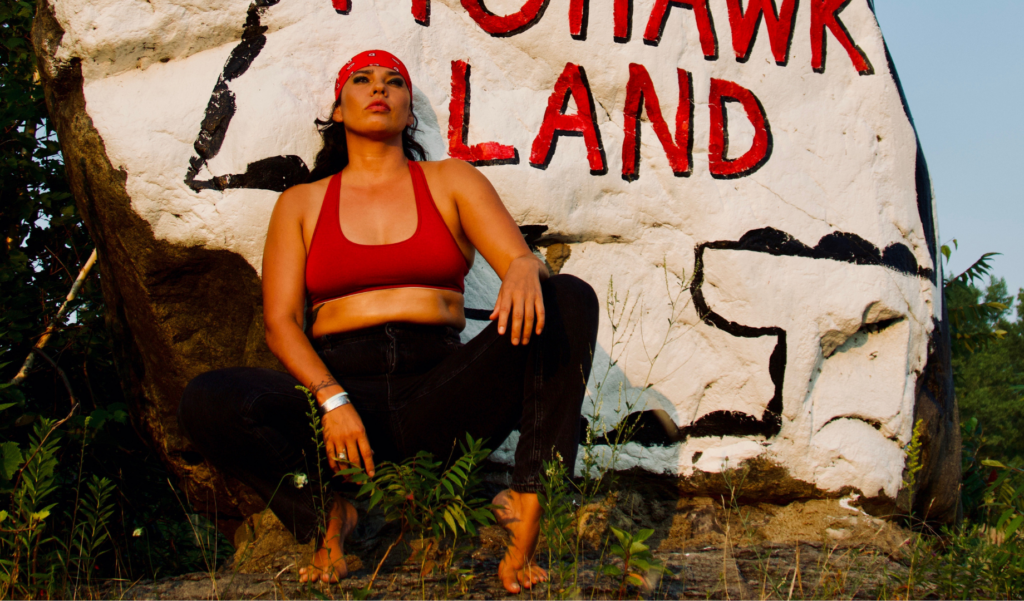
Bio
Lindsay Katsitsakatste Delaronde
Lindsay Katsitsakatste Delaronde is a Haudenosaunee woman from Kahnawà:ke and a member of the Wolf Clan. She is currently enrolled as a PhD student in the Indigenous Governance program and holds the Audain Professorship in the Visual Arts Department at the University of Victoria. As a multidisciplinary artist and scholar, she engages in Indigenous arts, culture and governance theory and research with the consciousness of the Haudenosaunee Confederacy woven into the essence of her being.
As a descendant of those who once built palisades, raised longhouses, and pounded corn, she is not separate from these cosmologies and teachings—she is their living, embodied constellation. She carries forward matrilineal knowledge, cultural resilience, and land-based traditions that have sustained her people for generations. This lineage shapes both her academic research and her artistic practice.
She holds a Bachelor of Fine Arts from Emily Carr Institute of Art & Design, a Master of Fine Arts from the University of Victoria, and a Master’s degree in Indigenous Communities Counselling Psychology, also from UVic. Her interdisciplinary education informs an artistic practice that is embodied, relational, and deeply attentive to emotional, cultural, spiritual and land-based ways of knowing.
Her artistic practice focuses on Indigenous dance and theatre, land-based dramaturgy, embodiment, performance, collaborative process, and decolonial methodologies. Through these practices, she explores the somatics of sovereignty, restores relational understanding, and reimagines Indigenous ways of making through ethical, relational, and culturally grounded approaches. Her work draws upon Indigenous aesthetics shaped by Haudenosaunee epistemologies, engaging themes of identity, politics, healing, resurgence, renewal, social responsibility, and human rights.
She weaves culture, art, history, ceremony, healing, spirituality, breath, song, movement, human development and mindfulness into the tapestry of the creative process to support the re-visioning of Indigenous futurities of hope and beauty. Transcending the intergenerational soul wound through the impasse of the radical creative spirit is what she strives to offer in her work.
-
Accessibility
Art Museum at the University of Toronto - University of Toronto Art Centre
Accessible entrance and washrooms
Accessible ramps / elevators
AODA compliant building
Accessible parkingUniversity of Toronto Art Centre (15 King’s College Circle) Accessible Entrance: There is a ramped entrance at the northwest corner of University College (near the Croft Chapter House).
-
Getting There
Art Museum at the University of Toronto - University of Toronto Art Centre
TTC: Museum Station; Queen’s Park Station; 506 Carlton streetcar; and the Route 5 bus
Bike Share: Willcocks St / St. George St and Wellesley St W / Queen’s Park Crescent
Donors & Supporters
Partners
